AISearch
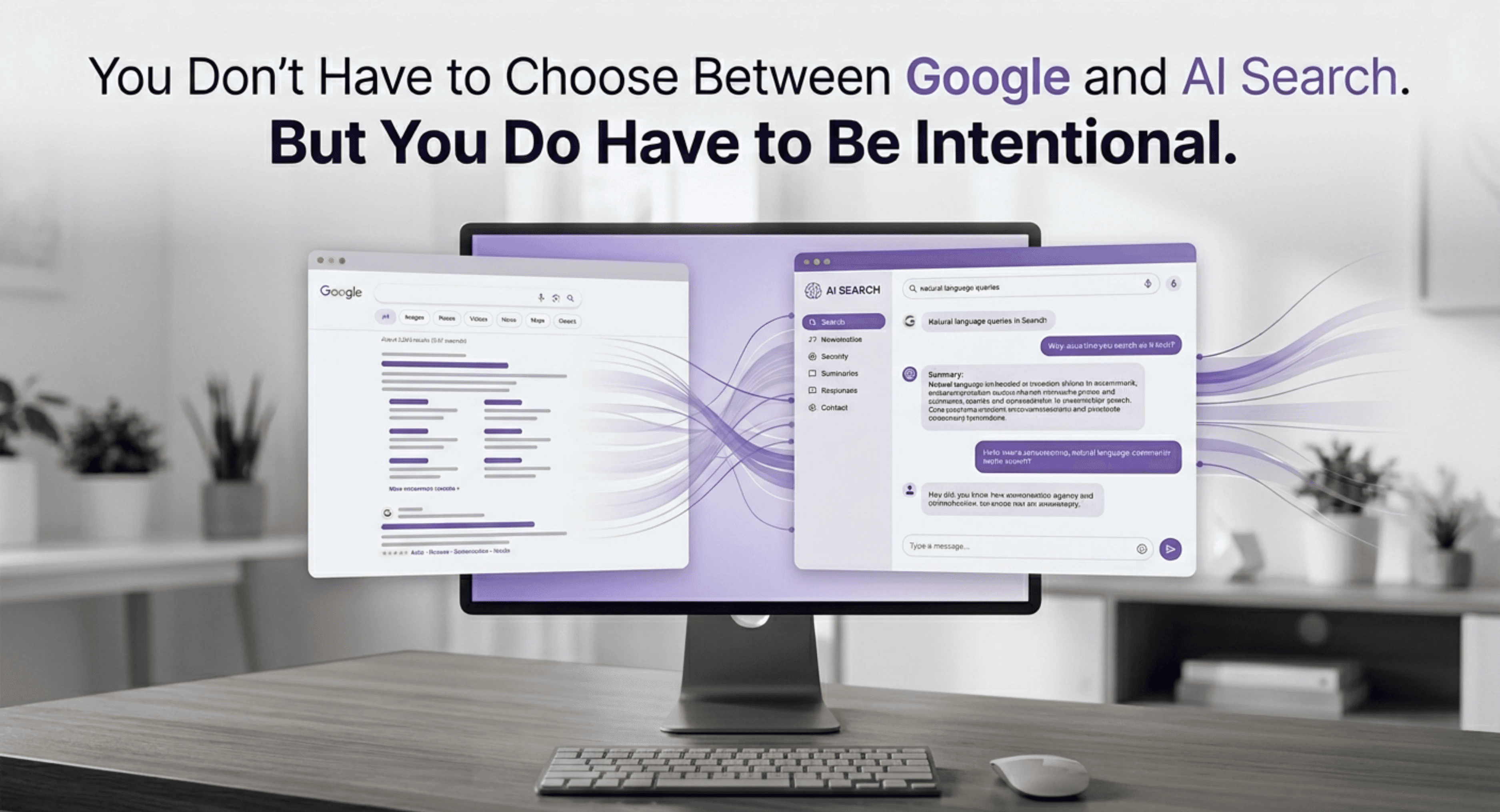
You Don't Have to Choose Between Google and AI Search.
You Don't Have to Choose Between Google and AI Search. But You Do Have to Be Intentional.
Most brands measure their Google performance obsessively. Rankings, traffic, click-through rates. They know exactly where they stand.
Ask those same brands how they're performing in AI search, and you get silence.
That's flying blind on half the search landscape. And in 2026, that half is growing fast.
The Debate Getting Framed Wrong
There's a conversation happening in marketing circles right now that's framed as a choice: optimize for Google, or optimize for AI.
It's the wrong question.
The Two Audiences You're Writing For
When someone searches on Google, they're looking for a link to click. They want to go somewhere: your site, your blog, your landing page. Google's job is to rank the best destinations.
When someone asks an AI, they're looking for an answer. They don't want to go anywhere. They want the AI to do the work for them: summarize, recommend, compare.
Same person. Different mode. Different expectation.
If you only optimize for Google, you're winning clicks but losing the conversation that happens before the click.
If you only optimize for AI, you might get mentioned in an answer but have no place to send someone who wants to go deeper.
You need both. Not because it's the safe answer, but because your buyers are using both. They ask an AI to get oriented, then they go to Google when they're ready to evaluate. If you're not showing up in either moment, you're invisible twice.
What "Optimizing for the Answer" Actually Means
It doesn't mean abandoning keywords or ignoring rankings. It means asking a different question before you write anything:
If an AI were asked about this topic, what would make it cite us?
AI models pull from sources that are clear, specific, and authoritative. They favor brands that say something definitive, not brands that hedge everything with "it depends."
That means:
Taking a clear point of view in your content
Using language that mirrors how questions are actually asked
Being the source that defines terms, not just uses them
Building a body of content that consistently reinforces your expertise in one area
What Google Still Gets Right
Google still drives the majority of web traffic. It's still where buyers go when they're ready to evaluate, compare, and decide.
And here's the thing: the signals that make you rank well on Google (authority, relevance, trust) are the same signals that make AI models more likely to cite you.
A well-structured, clearly written, expert piece of content doesn't just rank. It trains.
The brands that will win the next five years are the ones building content that serves both at once: content that earns rankings and earns citations.
The Measurement Problem
You can't optimize what you can't see.
Most brands have no visibility into whether AI models mention their brand, recommend their competitors, or ignore their category entirely. Google Search Console tells you half the story. The other half has no dashboard.
That's the gap Podium IQ was built to close.
The Bottom Line
Don't let anyone tell you Google is dead or that AI has replaced search. Both are true at once: Google still matters, and AI is changing how answers are formed before anyone ever clicks.
The brands pulling ahead aren't choosing between the two. They're measuring both, optimizing for both, and making sure their voice shows up wherever the answer comes from.
Want to know where you stand in AI search? Get your free GVI Score at podium iq.