Generative Engine Optimization (GEO)
Why GEO isn’t AI search and why CMOs can’t afford inaction
For the last two decades, marketing teams have been trained to think in terms of rankings, keywords, and page-one visibility (those blue links). If you controlled the SERP, you owned the moment of consideration.
However, that world is changing rapidly. The world has changed.
Today, more and more buyers aren’t going to Google to compare options. They’re asking ChatGPT, Perplexity, Claude, Gemini, and other AI answer engines questions like:
“What’s the best payroll software for a 50-person company?”
“Which CRM is easiest for a sales team to onboard?”
“What’s the best alternative to HubSpot?”
And instead of delivering 10 blue links, the AI delivers one synthesized answer. One recommendation. One winner. The search ends before the click.
If your brand isn’t in that answer, it doesn’t matter how strong your SEO is. You’re invisible in the buying moment.
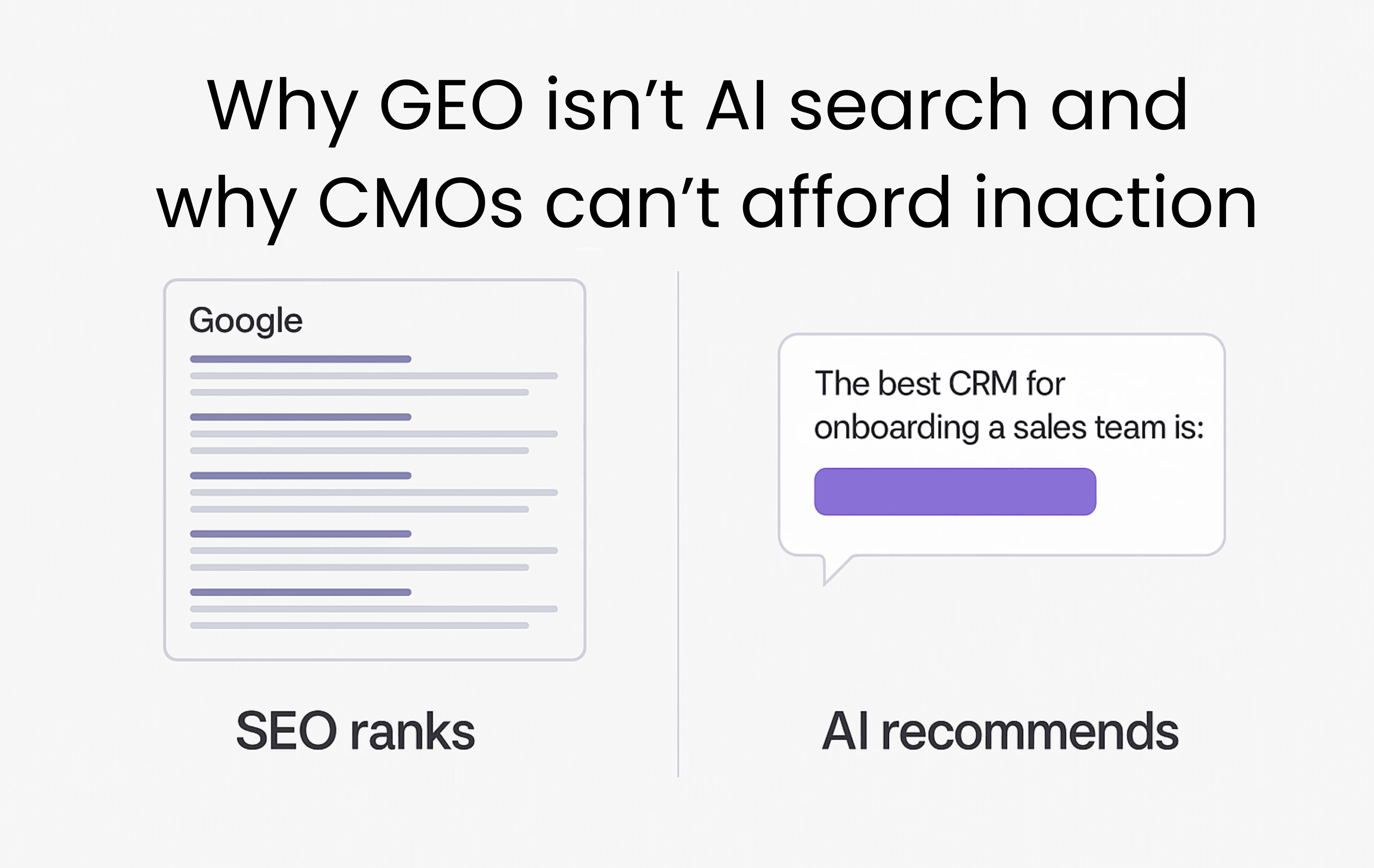
So let’s make this clear:
SEO is about ranking.
GEO (Generative Engine Optimization) is about being recommended.
SEO asks: “Where do we appear on Google?”
GEO asks: “Does the AI even mention us?”
And those are two completely different battles.
In GEO, the competitive set changes, too
In traditional search, you compete for keywords.
In AI answer engines, you compete for narrative space, the right to be included in the model’s reasoning.
That’s why GEO is not “AI search.”
AI search is still about queries, clicks, and traffic.
GEO is about presence, authority, and model-level trust.
It’s not just “Are we ranking?”
It’s: Are we cited?
Are we recommended?
Are we described accurately?
Are we missing from key decision queries that ur competitors appear in?
That’s a brand problem, not a keyword problem.
What this means for CMOs
Your website is no longer the final destination for your brand.
AI doesn’t care about click-through rate. It considers whether your brand is credible enough to be included as an answer.Visibility is binary now.
On Google, being #8 still gave you impressions.
In AI answers, you're either in the response or you're not.You need new metrics.
Keyword rank won’t tell you whether ChatGPT recommends you.
That’s why platforms like podium iq created the GVI (Generative Visibility Index) because CMOs need a way to measure whether they are winning inside AI, not just on Google.
If you want to see where your brand stands today:
You can get an AI Visibility Brief: a snapshot of how often your brand is mentioned across top AI models, where you're being out-recommended, and what queries you're completely absent from.
The score is just the starting point.
The real value is the competitive insight that follows.
Click this button to find out your brand's AI visibility :