AI Search
The Visibility Gap: Why AI Search ROI Evades the Enterprise and How to Close It
Written by Alexandra Kolar, head of advisory podium iq
Most enterprise marketing teams know AI search is changing how buyers find answers, and almost none have the infrastructure to know whether their content is part of that answer.
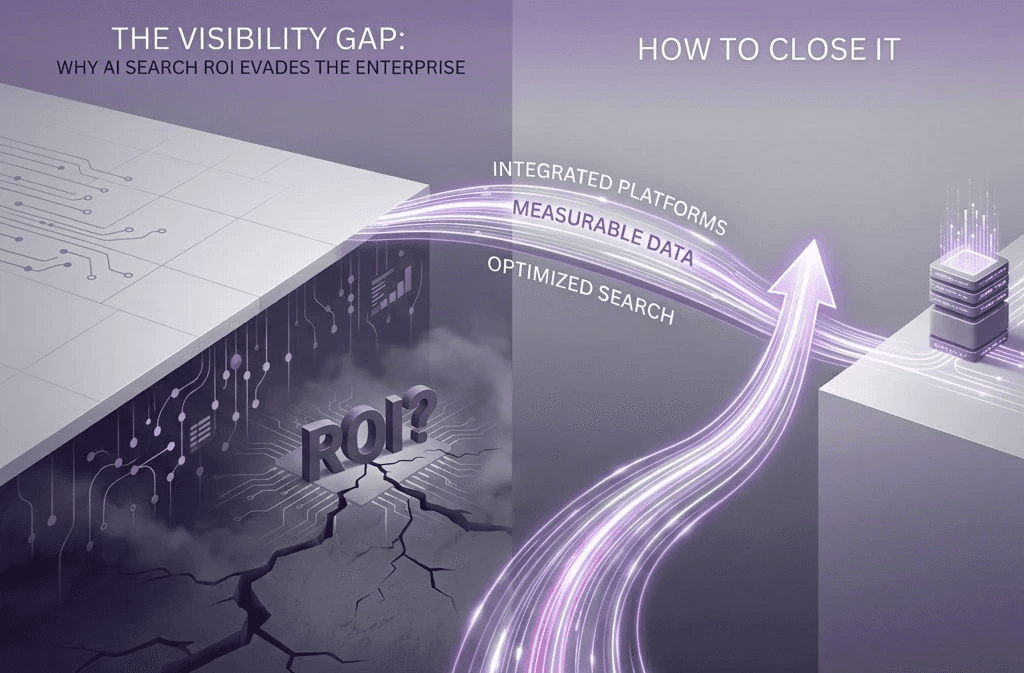
The gap between execution and evidence
AI Engine Optimization has moved fast as a concept. Brands understand, at least in principle, that large language models now sit between their content and their customers. They know that being cited by Claude, Perplexity, or ChatGPT is a different kind of visibility than a top-ten Google ranking. But most haven't yet built the infrastructure to compete for that visibility, or to know whether their current content is earning it.
Winning in AI search has three distinct failure modes.
The first is diagnosis: not knowing where you stand or what the models are surfacing instead of you.
The second is execution: knowing the gaps but lacking a clear process to close them.
The third is measurement: executing against a strategy with no reliable signal that it's working.
Many conversations about AEO focus on the first two. Today we’re talking about the third.
"Most teams are executing without evidence. The feedback loop is the missing piece."
The problem is structural. Most enterprise teams are measuring AI search performance through periodic audits: someone manually querying models every few weeks, logging what comes back, and reporting upward. That process produces data, but it doesn't produce a signal. By the time a quarterly report surfaces a citation pattern, the underlying content's already been live for months. The feedback loop's too slow to inform anything in real time.
The result is a familiar form of capital inefficiency. Resources keep flowing to tactics that stopped converting. Tactics that are working don't get standardized quickly enough. And when the CFO asks what the AI search strategy is actually producing, the honest answer is usually: we're not sure yet.
Citation velocity: the operating signal you're missing
What enterprises actually need isn't more data about AI citations. They need the right data, at the right speed, connected to the right decisions.
Citation velocity is the rate at which new content moves from publication to citation across LLMs. It turns the question from "are we being cited?" to "what's getting cited, when, and why?" That shift changes the function of AI search measurement from a reporting exercise to an operating one.
Automated citation monitoring closes the distance between "asset live" and "asset cited." More importantly, it surfaces the diagnostic underneath the result: not just that a piece of content is being cited, but which structural elements are driving the citation, and which are actively working against it.
Consider what recently happened with a podium iq client.
What a real signal looks like in practice
The detection: Three days after publishing new content built to earn AI citations, podium iq's monitoring infrastructure flagged an active pickup from Claude. Eight days later, Perplexity cited the same asset independently.
The result: Two things became visible that would have been invisible without automated monitoring. First, the team had a documented, timestamped record of exactly when their content entered model-generated answers, tied directly to the content decision that produced it. Second, they could see the sequence: Claude indexed it first, and Perplexity followed. That propagation pattern, captured in near real time, provides insight on how citation momentum actually builds and gives a concrete baseline for how fast well-structured content can move from publication to model-level visibility.
The broader value: A manual audit cadence would have surfaced these citations eventually, but weeks later and stripped of context. The timestamps would be missing. The sequence would be invisible. What makes this a playbook asset, is that the detection happened fast enough to matter. The team now knows their content moved from publication to first citation in 3 days, with multi-engine spread following within the week. Every subsequent content decision has something real to measure against.
This is a marketing efficiency question, not a content question.
What the case study above actually demonstrates isn't just a content win. It's an instrumentation win. The asset earned citations because it was built to. The monitoring made that visible fast enough to matter. CMOs navigating this moment are carrying a specific kind of pressure. AI search has been sold internally as a strategic priority. Boards and CFOs are asking what it's producing. The honest answer for most teams is that they don't yet have the instrumentation to answer precisely.
"If you don't know what's landing, you're misallocating a significant portion of your marketing and SEO budget. Not because the strategy's wrong, but because you can't see well enough to optimize it."
The brands that will pull ahead in AI search aren't necessarily the ones with the biggest content operations. They're the ones with the tightest feedback loops. They know what's converting. They standardize what works across the portfolio before competitors notice the pattern. And when the CFO asks, they've got a precise, defensible answer.
The Takeaway
The strategic question for enterprise teams right now isn't only "should we invest in AEO?" It's also "do we have the infrastructure to know if it's working?" Without that answer, any investment is hard to defend and harder to scale.
Real-time citation monitoring is the telemetry layer that connects execution to evidence, content decisions to budget allocation, and marketing leadership to a number they can actually stand behind in the room.
A good place to start is understanding where your brand stands today. A GVI Snapshot gives you a competitive read on your current AI visibility position across the major LLMs and a clear picture of what it will take to move the needle.
See where your brand stands across Claude, ChatGPT, and Perplexity.
Get your GVI Snapshot and start the conversation with the podium iq team.