AI Marketing
The Four Layers of Modern Marketing
For most of marketing history, the job was straightforward: reach the right human, with the right message, at the right time.
That's still true. But "right" has gotten a lot more complicated.
Today, your brand isn't just being evaluated by consumers scrolling their feed. It's being parsed by developers building on your platform, indexed by AI models answering questions, and increasingly selected (or rejected) by AI agents acting autonomously on behalf of the people you're trying to reach.
That's four distinct audiences. Four different languages. Four sets of signals that determine whether your marketing works.
At Podium, we built podium iq because we saw this coming. The businesses that thrive in the next decade won't just have great marketing. They'll have marketing that works across all four layers at once.
"The brands that win the next decade won't just be well-known. They'll be well-structured for humans and machines alike."
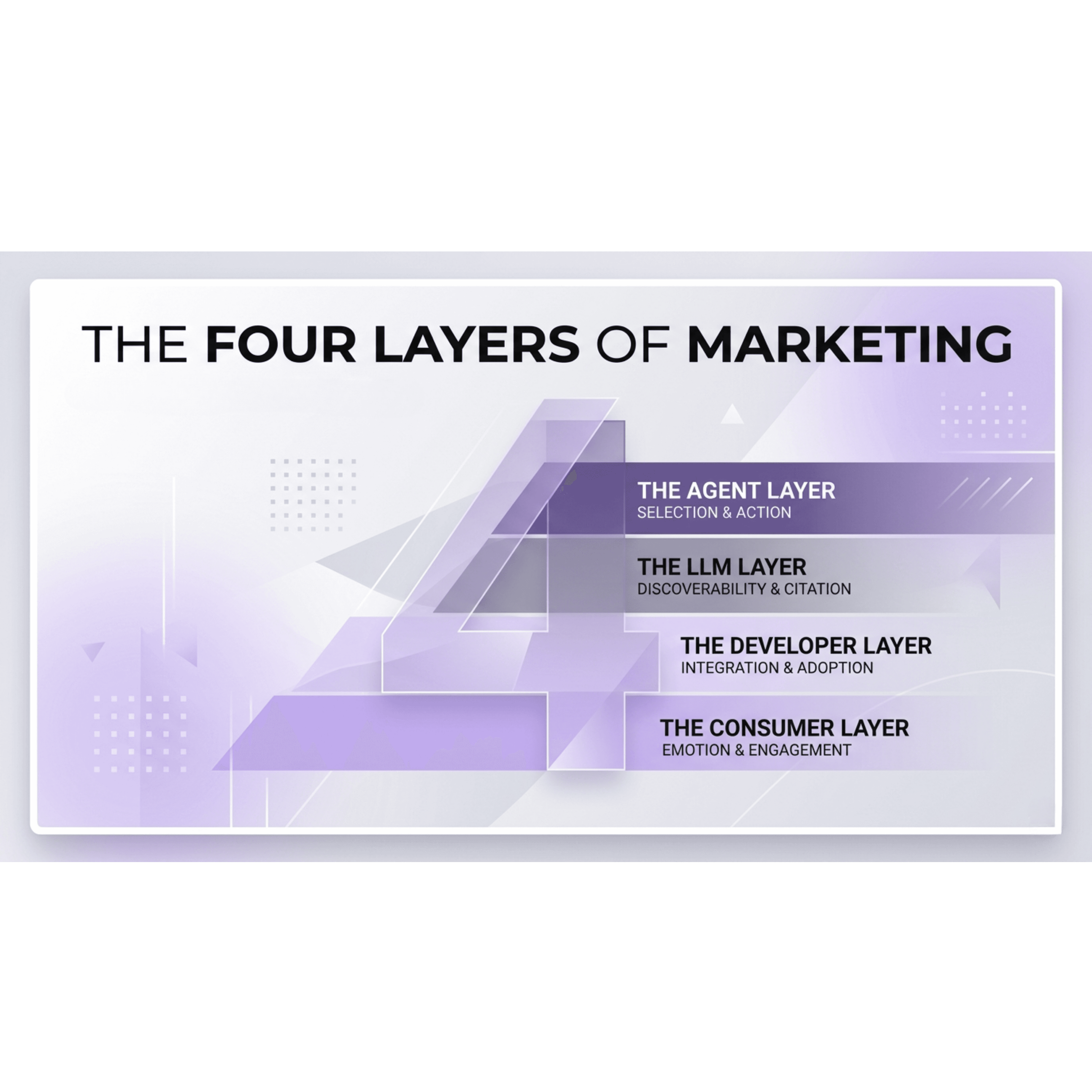
The Four Layers
Layer 1
The Consumer Layer
This is the layer marketers have always known. It's the emotional, visual, human layer: the story you tell, the brand you build, the feeling someone gets when they interact with your product. It's scroll-stopping creative, compelling copy, and a brand voice people recognize and trust.
The Consumer Layer is about resonance. It asks: Does this move someone?
Goal → Emotion & Engagement
Layer 2
The Developer Layer
As software eats the world, a critical audience has emerged: the builders. Developers evaluate your APIs, read your documentation, and decide whether to integrate your product into theirs. For many SaaS and platform companies, developer adoption is the growth engine.
Marketing to developers isn't about persuasion. It's about clarity, reliability, and trust. They want to know: Can I build on this? Will it break?
Goal → Integration & Adoption
Layer 3
The LLM Layer
This one is new, and most brands are completely unprepared for it. When someone asks ChatGPT, Claude, or Gemini "what's the best tool for X?" your brand either shows up or it doesn't. Large language models are trained on your content, your documentation, your reviews, your press. If that content isn't clear, structured, and authoritative, you're invisible in the most important new search surface of our time.
The LLM layer asks: Is your brand legible to a machine? Can an AI accurately describe what you do, who you serve, and why you're credible?
Goal → Discoverability & Citation
Layer 4
The Agent Layer
The newest and perhaps most consequential layer. AI agents don't just answer questions. They take action. They book appointments, compare vendors, fill out forms, and make purchasing decisions on behalf of users. As agentic AI becomes mainstream, your brand will need to be not just findable by AI, but selectable by it.
The Agent Layer asks: When an AI is choosing on someone's behalf, will it choose you? That means machine-readable pricing, structured trust signals, clear differentiation, and frictionless integration paths.
Goal → Selection & Action
Why Most Marketing Teams Are Behind
The secret of modern marketing is that teams are still organized around the Consumer Layer. Social, paid, email, content: all human-facing, all optimized for clicks and conversions from people.
Developer marketing exists in some orgs, but it's often siloed in product or DevRel, disconnected from the brand strategy.
LLM optimization is barely on anyone's roadmap. Most marketers know they should care, but haven't operationalized it. And Agent Layer marketing? It's almost entirely uncharted territory.
The opportunity here is enormous precisely because so few are doing it. That's why podium iq was built to surface insights across all four layers simultaneously, giving your team a unified view of how your brand performs with every audience that matters.
What Multi-Layer Marketing Looks Like in Practice
The good news: you don't need four separate teams or four separate strategies. You need one coherent brand story expressed across four different registers.
Here's a simple example. Imagine you're launching a new feature:
Layer | Audience | What you produce | Goal |
|---|---|---|---|
Consumer | End users | Social post, video, email campaign | Awareness & desire |
Developer | Builders & integrators | API docs, changelog, SDK update | Adoption & integration |
LLM | AI models | Structured blog, schema markup, authoritative FAQ | Accurate citation |
Agent | AI acting for users | Machine-readable specs, structured data, clear CTAs | Autonomous selection |
The feature is the same. The story is the same. But how you tell it and to whom changes at every layer.
The Brands That Get This Will Win
We're at an inflection point. The brands that treat their content as infrastructure, structured, layered, machine-legible, and human-compelling, will have a compounding advantage over the next decade.
The ones that don't? They'll keep optimizing click-through rates while an AI agent recommends their competitor without a second thought.
podium was built for this moment. From real-time social monitoring to AI-ready content intelligence, podium iq gives marketing teams the visibility they need to show up powerfully at every layer.
The question isn't whether your marketing needs to evolve. It's whether you'll build for all four layers before your competitors do.
"You're not just writing for people anymore. You're writing for the systems that talk to people."